
Apply Now

About School Outreach

The School Outreach Programmes by Educational Outreach at IIT Bombay introduce students from grades 8 to 12 to emerging fields such as robotics, artificial intelligence, design thinking, UX design, and sustainability through immersive, hands-on learning experiences.

Conducted on the IIT Bombay campus and led by institute experts, these workshops enable students to explore how science, engineering, and design intersect to solve real-world problems.

The initiative engages
a broader ecosystem of stakeholders

Students through early exposure to future-ready domains

Teachers through NEP-aligned professional development

School leadership through institutional collaboration

Through these initiatives, Educational Outreach aims to encourage curiosity, enable informed academic exploration, and create pathways into advanced learning experiences for a younger audience at IIT Bombay.

Educational
Outreach
Impact

35,000+

Learners Impacted

800+

Programmes Delivered

300+

Partnerships

100+

Disciplines Covered

School
Outreach

Impact

School Outreach is a key part of the Educational Outreach ecosystem, enabling early-stage exposure to technology, design, and innovation.

110+ School Students

Engaged through outreach initiatives

Multi-Board Engagement

(CBSE, State Boards, Institutional Schools)

NEP-aligned professional development initiatives for educators, creating a ripple effect across classrooms and institutions. Our programmes provide early-stage exposure to technology, design, and innovation—equipping students with future-ready skills.


x

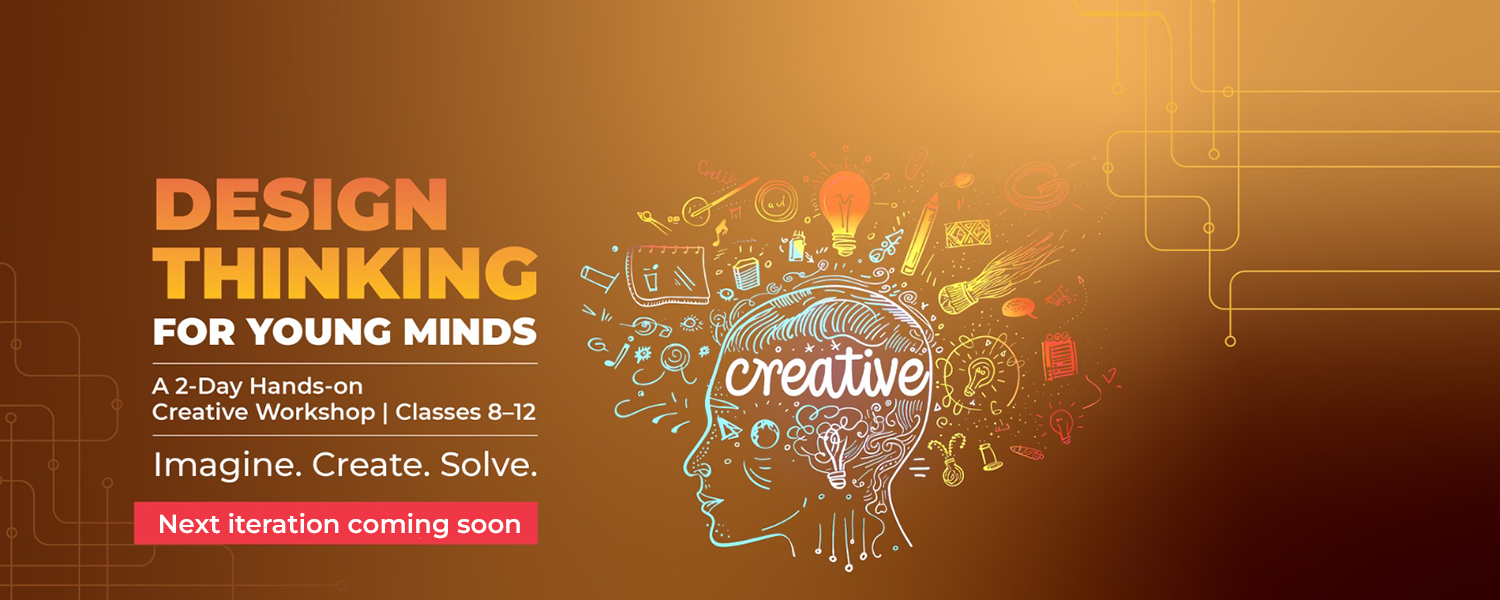
Design Thinking for Young Minds

Introduction: A 2-Day Hands-on Creative Design Workshop for School Students (Class 8–12) Design is all around us. Every object we use, every space we walk through, every digital app we interact with, and even the systems through which we learn, travel, or communicate. All of these are designed. At its simplest, design is the thoughtful act of improving how people live, learn, work, and experience the world. It combines creativity with problem-solving, and imagination with practicality. For students, understanding design opens up a new way of seeing everyday life: not as something fixed, but as something they can shape. Design is a vast and exciting universe with many fields: product design, communication and graphic design, animation and game design, interaction and UX/UI design, fashion and textile design, mobility and vehicle design, architectural and spatial design, service design, and many more. Each field focuses on solving problems through observation, creativity, and empathy. What connects all of them is a simple question: How can we make experiences better for people? Young learners constantly notice problems around them; from difficult-to-use classroom objects to confusing bus routes or uncomfortable public spaces; but they often do not know how to explore these problems creatively or collaboratively. Design Thinking, a human-centred approach to innovation, gives them this power. It helps students observe deeply, understand users, generate ideas without fear, build quick prototypes, and learn by testing solutions. This two-day hands-on workshop brings design to life through games, team challenges, sketching, storytelling, and model-making. Students learn by doing, experimenting, and expressing. By the end, they gain creative confidence, stronger teamwork skills, and a new lens to understand the world. Most importantly, they realise that design is not just a career, it is a way of thinking that empowers them to imagine and build a better future.
Course Outline: KEY OBJECTIVES / LEARNING OUTCOMES 1. Understand What Design Is Students will learn that design is all around us; from products they use, to apps, and discover the different fields of design in a simple, fun way. 2. Build Creativity & Imagination Students will practice thinking differently, exploring new ideas, and expressing their imagination through quick, playful activities. 3. Solve Problems with Empathy Students will learn how to observe people, understand their needs, and design solutions that make life easier, safer, or more enjoyable. 4. Work Together to Create & Present Solutions Students will collaborate in teams to create simple prototypes, test their ideas, and confidently share their designs with others. CURRICULUM A) Through Introductions, Stories & Interactive Sessions 1. Understanding Design • What is design? Why does everything around us have a designer? • Differentiating design from decoration; purpose, function, and experience. • Examples from everyday life: objects around us, apps, seats, transport, packaging etc 2. Introduction to Design Fields Overview of major design domains: • Product Design • Communication & Graphic Design • UX / UI & Interaction Design • Animation & Game Design • Mobility & Vehicle Design Why all designers follow a human-centric approach. 3. Overview of Design Thinking • Five stages: Empathise, Define, Ideate, Prototype, Test • Why human-centred innovation matters • How young learners can use Design Thinking in life B) Through Fun, Hands-on Activities & Teamwork i) Empathise: Understand People Students learn to observe others, ask simple questions, and listen to their stories. ii) Define: Choose the Right Problem Teams look at everything they discovered and pick one meaningful problem to solve. iii) Ideate: Come Up With Creative Ideas Students learn to think freely and imagine lots of possibilities; serious, silly, futuristic, anything! iv) Prototype: Build Your Idea Students make simple models of their ideas using paper, cardboard, clay, sticks, or any craft material. v) Test: See What Works Students show their prototypes to others and get friendly feedback. vi) Final Showcase: Teams proudly present their best ideas and models to the class.
WHO MAY BENEFIT: • Students from Class 8 to 12 who are curious, creative, or simply enjoy exploring new ideas. • Students who like solving problems, big or small, in school, at home, or in their community. • Students who enjoy drawing, making, building, or storytelling, and want to use these skills in meaningful ways. • Students who want to learn teamwork, communicate better, and share ideas confidently. • Students interested in design careers such as product design, animation, graphic design, fashion, UX/UI, architecture, mobility design, and more. • Students who love science, technology, mathematics, or humanities but want to combine these with creativity and innovation. • Students who enjoy making things with their hands; craft, models, DIY projects, mini inventions. • Any student who wants to grow as an innovator, thinker, and problem-solver, regardless of their academic background.
HANDS ON FACILITY: Design Thinking Studio RBTIC IIT Bombay
OTHER INFORMATION: Please use the Google Form temporarily, until the dedicated form is developed.
Download Brochure:
Not Available
Coordinator: Prof. Nishant Sharma
Course Duration: 2 Days
Dates: 02/05/2026 - 03/05/2026
Venue: Design Thinking Studio   
Fees: (inclusive of 18% GST) Others: INR 5900
x

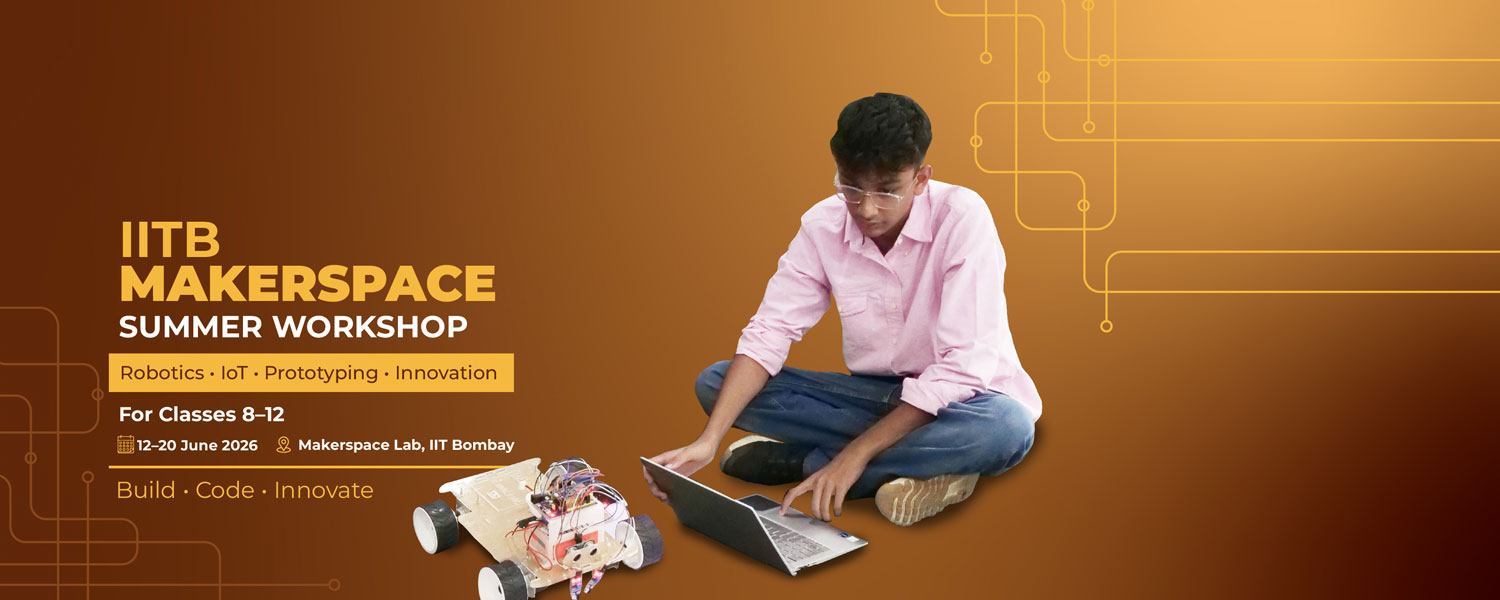
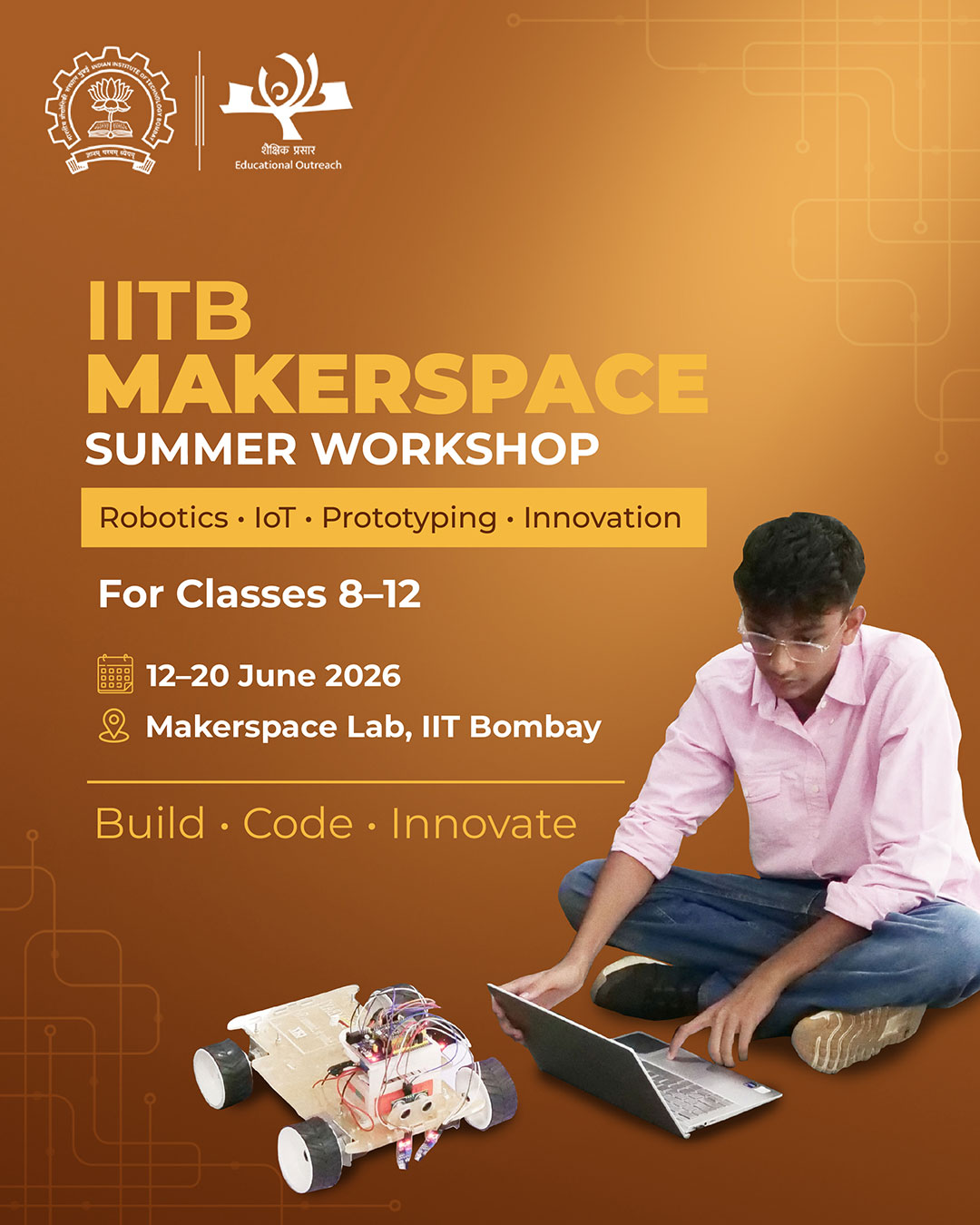
IITB Makerspace Summer Workshop

Introduction: The MakerSpace Summer Workshop 2026 is an immersive, hands-on learning experience focused on robotics, automation, and smart systems. Participants will explore mechanical fabrication, electronics and programming to develop a fully functional autonomous robot. Students will gain expertise in: ● Mechanical Prototyping – using 3D printers, laser cutters, lathe machines, grinding tools, vacuum forming and hand power tools. ● IoT & Automation – ESP32 programming, sensor integration, motor control and real-time IoT automation. ● Autonomous Navigation – Implementing obstacle detection, smart parking and payload handling. Under the mentorship of IIT Bombay faculty and robotics experts, students will develop problem-solving skills and apply their knowledge in competitive robotics challenges and technical showdowns.
Course Outline: Day 1-3: Introduction & Mechanical Prototyping ● Workshop Overview ● CAD Modeling ● Additive Manufacturing Day 4-6: Electronics & IoT Integration ● Electromechanical Interfacing ● Microcontroller Coding (ESP32 + WiFi-controlled) ● Autonomous App Design Day 7-9: Smart Systems & Final Showcase ● Feature Integrations (Smart Parking, Payload Handling, Obstacle Detection) ● Project Exhibition
WHO MAY BENEFIT: School students from 8th to 12th standards
HANDS ON FACILITY: Makerspace lab will provide access to all the prototyping, electrical design and fabrication equipment and software.
OTHER INFORMATION: Early bird fee: ₹30,000 + 18% GST. Early bird registration deadline: 11th May, 2026. Early bird fee payment deadline: 13th May, 2026. Late fee: ₹37,500 + 18% GST. Late registration deadline: 25th May, 2026. Late fee payment deadline: 27th May, 2026. Fees will be non-refundable after the registration deadline closes (to be mentioned on promotional materials). A second workshop of 9 days can be planned from 12th-20th Jun, 2026 if there are a large number of registrations.
Download Brochure:
Not Available
Coordinator: Prof. Darshan Shah
Course Duration: 9 Days
Dates: 02/06/2026 - 10/06/2026
Venue: Makerspace Lab,1st Floor,DESE Building  
Fees: (inclusive of 18% GST)
Others:INR 44250
x

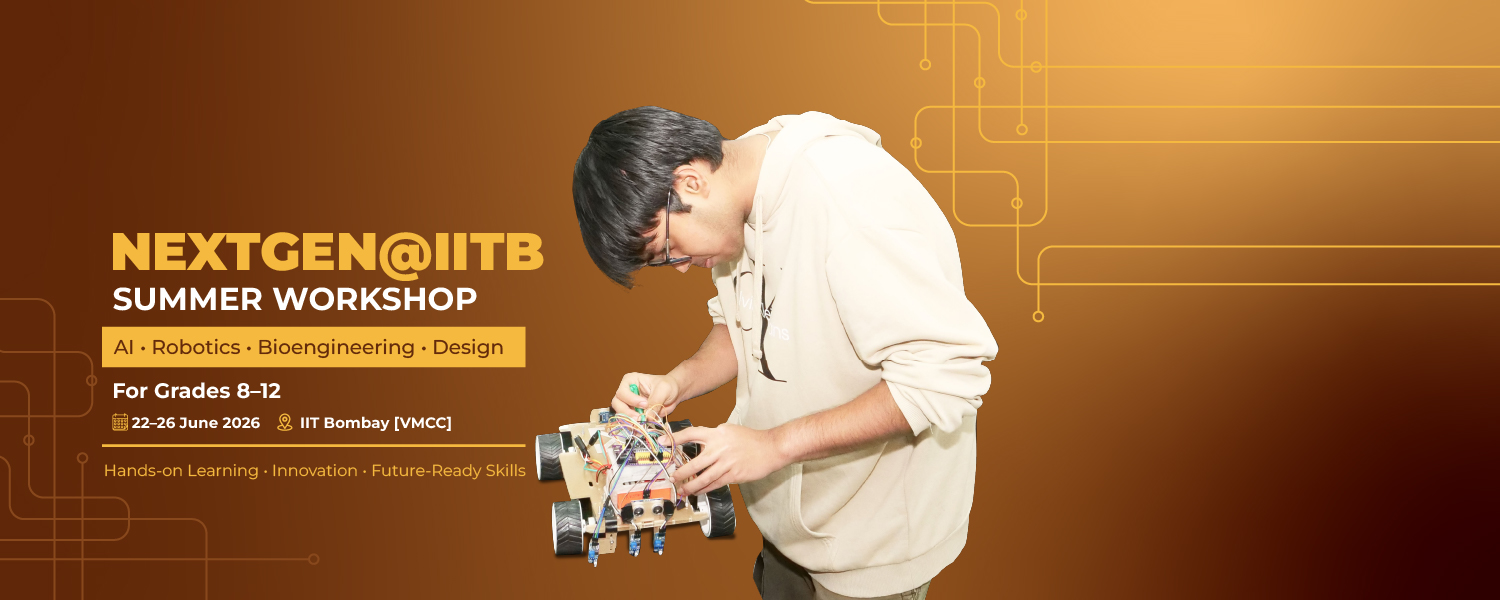
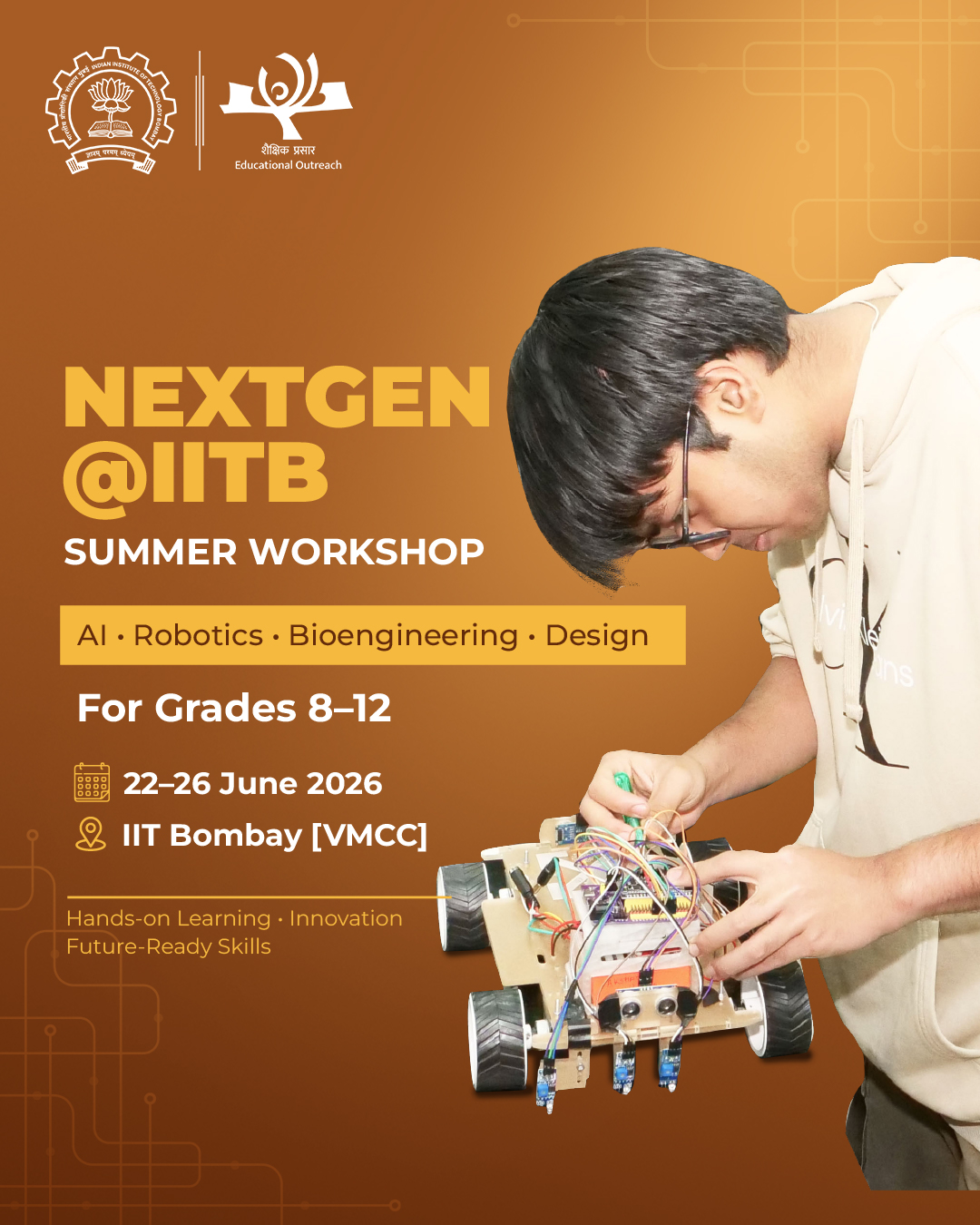
NextGen@IITB Summer School

Introduction: NextGen@IIT Bombay is a five-day interdisciplinary, day-scholar summer programme designed for students from Grades 8 to 12. Offered by the Educational Outreach division at the Indian Institute of Technology Bombay, the programme provides early exposure to key domains such as Artificial Intelligence, Robotics, Bioengineering, Design Thinking, and Innovation. Through a structured combination of concept sessions and hands-on learning, students engage with real-world applications under the guidance of faculty members, researchers, and innovation labs across IIT Bombay.
Course Outline: • Programme orientation and introduction to the IIT Bombay ecosystem • Artificial Intelligence & Future Technologies sessions • Robotics & Intelligent Systems (SysCon) exposure • Makerspace: prototyping, design, and innovation sessions • Biosciences & Bioengineering: theory and lab exposure • Design Thinking workshop and problem-solving approaches • Student reflection, showcase, and valedictory session
WHO MAY BENEFIT: • Students currently enrolled in Grades 8 to 12 • Those with an interest in science, engineering, innovation, or design • Learners who prefer experiential and hands-on learning environments • Students seeking early exposure to IIT-level academic and research ecosystems
HANDS ON FACILITY: • Access to Makerspace IIT Bombay for prototyping and innovation activities • Exposure to Robotics and Systems labs • Interaction with bioscience laboratories and experimental setups • Engagement with design and innovation spaces at IDC School of Design • Guided exposure to IIT Bombay’s academic and innovation ecosystem • IIT-B EO certificate of Participation.
Download Brochure:
Not Available
Coordinator: Prof. Usha Ananthakumar
Course Duration: 5 Days
Dates: 22/06/2026 - 26/06/2026
Venue: IIT, BOMBAY [VMCC]  
Fees: (inclusive of 18% GST) Others: INR 82600
x

NextGen@IITB BMC Schools Edition

Introduction: NextGen@IIT Bombay is a five-day interdisciplinary, day-scholar summer programme designed for students from Grades 8 to 12. Offered by the Educational Outreach division at the Indian Institute of Technology Bombay, the programme provides early exposure to key domains such as Artificial Intelligence, Robotics, Bioengineering, Design Thinking, and Innovation. Through a structured combination of concept sessions and hands-on learning, students engage with real-world applications under the guidance of faculty members, researchers, and innovation labs across IIT Bombay.
Course Outline: • Programme orientation and introduction to the IIT Bombay ecosystem • Artificial Intelligence & Future Technologies sessions • Robotics & Intelligent Systems (SysCon) exposure • Makerspace: prototyping, design, and innovation sessions • Biosciences & Bioengineering: theory and lab exposure • Design Thinking workshop and problem-solving approaches • Student reflection, showcase, and valedictory session
WHO MAY BENEFIT: • Students currently enrolled in Grades 8 to 12 • Those with an interest in science, engineering, innovation, or design • Learners who prefer experiential and hands-on learning environments • Students seeking early exposure to IIT-level academic and research ecosystems
HANDS ON FACILITY: • Access to Makerspace IIT Bombay for prototyping and innovation activities • Exposure to Robotics and Systems labs • Interaction with bioscience laboratories and experimental setups • Engagement with design and innovation spaces at IDC School of Design • Guided exposure to IIT Bombay’s academic and innovation ecosystem • IIB EO certificate of Participation.
Download Brochure:
Not Available
Coordinator: Prof. Usha Ananthakumar
Course Duration: 5 Days
Dates: 29/06/2026 - 03/07/2026
Venue: IIT, BOMBAY [VMCC]
Fees: (inclusive of 18% GST) Others: INR 1180
x

Infinity Juniors – Entrepreneurship Bootcamp

Introduction: India’s most successful entrepreneurship scholarship export, Prof Saras Sarasvathy, has compellingly argued that entrepreneurship is not a career path reserved for a bold few, but a fundamental life skill to be developed and leveraged by all (Sarasvathy & Venkataraman, 2011). Her decades of research, including her groundbreaking work on effectuation, has shown that expert entrepreneurs do not predict the future and plan to conquer it. Instead, they work with what they have, embrace uncertainty, and build as they go. Working with effectual logic is not a personality type but a way of working which is becoming increasingly valuable in the dynamically uncertain world which awaits our children. Given that individual dispositions and thinking processes are formulated during school days in large parts (Bourdieu, 1984; Pratap & Saha, 2018), waiting until university, or until someone has "enough experience," would amount to not seeding an essential skill of our times, during the fundamental years of an individual’s development. That entrepreneurial thinking, practice and perspective should be cultivated early and deliberately is the philosophical backbone of this course curated for school-children by IIT Bombay.
Course Outline: The course will progress by building up skillsets and imparting perspectives in sequence A) Skillsets 1) Observation – the course begins with lesson around how to see the world around them. In the era of smartphones, blinded by our own comfort and privilege, most of us move through our daily lives on autopilot, blind to the friction, inefficiency, and unmet needs hiding in plain sight. This module will teach students to slow down, record their observations by paying attention, and ask why does this work this way? or who is being left out here? Fundamentally, it drives the point that everyday life is a laboratory, and immersion in the immediate context is all one needs to begin. 2) Problem Identification – students will learn how to frame and articulate problems of their interest, while identifying key stakeholders and staying within the realm of their own interest. Relative severity of candidate problems will be estimated and measures of situation at hand will be made. 3) Solution Building - This module teaches students that solutions can be a new process, a community initiative, a simple product, or even a behavioural nudge. Students will learn to brainstorm widely without judgment, evaluate ideas against real-world constraints like cost, feasibility, and impact, and then converge on the most promising direction. They will be encouraged to draw from their own lived experiences and the insights gathered during observation and problem identification, ensuring that their solutions are rooted in genuine understanding rather than assumption. Basic principles of design thinking will be taught. 4) Prototyping - students will be introduced to the art and discipline of building quick, rough, low-cost representations of their ideas — a sketch, a cardboard model, a roleplay, a mock app screen, or even a short demonstration. Students will learn that the purpose of a prototype is to invite feedback, and iterate before investing significant time or resources. They will go through at least one cycle of build, test, and improve, developing a comfort with imperfection and a bias toward action. 5) Storytelling - This final module teaches students that every innovator must also be a storyteller — someone who can make others feel the problem before presenting the solution. Students will learn to structure their narrative around three pillars: the human behind the problem, the journey of discovery, and the promise of the solution. Together, the five modules form not just a course curriculum but a complete way of being in the world — one that is curious, action-oriented, playfully creative, and empathetic. B) Perspectives 1) History of a city, its communities and associated entrepreneurial landscape 2) Ingenuity and enterprise of local businessmen 3) Social enterprises and their impact 4) Crisis and its impact on a geography, business, individuals 5) (Film) Industry as a matrix of entrepreneurial energy
WHO MAY BENEFIT: This course is designed specifically for students of Class 8 - 12. In particular, this will benefit two kinds of students a) creative and curious students - the course will serve as an outet for their energy and questions b) those who have got drawn into the digital world - the course will help them explore a different dimension of their personality
HANDS ON FACILITY: The POC lab at DSSE will be leveraged to build prototypes
OTHER INFORMATION: The course is being helmed by Prof Sankalp Pratap of the entrepreneurship school at IIT Bombay. An entrepreneur himself, he is invested in pursuits related to child development With a PhD (Strategy) and an MBA from IIM Calcutta and a B.Tech (Marine) from MERI Kolkata, Prof. Sankalp Pratap comes with a mix of corporate and academic experience at blue chip institutions. His doctoral research involved study of early age influences and its impact on an individual’s professional life. Derived from his interest in early stage development of children, he co-founded Hamari Laado (www.hamarilaado.org) which works towards development of girlchild from impoverished families in rural India, through an innovative copyrighted pedagogy aimed at fostering creativity, articulation and resilience. Prof Sankalp has spent 10 + years collectively in academic institutions (IIT Bombay, IIT Jodhpur and IIM Trichy), teaching strategic management, entrepreneurship and ethnography. In this period, he has actively led the design and execution of doctoral programs and administered bodies like e-cell and incubation centres. Before his PhD, his decade long corporate work experience spanned functions like Marketing, Operations, Business Consulting, Human Resources and Strategy in the Tata Group, Neptune Orient Lines Singapore and Infosys Technologies, where he got the opportunity to work with individuals across national and cultural boundaries. Prof Sankalp relies on his ethnographic skills for his research and practice, as also for exercising his interest in writing short stories for children.
Download Brochure:
Not Available
Coordinator: Prof. Sankalp Pratap

IITB Faculty: Prof. Ramesh Kuruva
Course Duration: 5 Days
Dates: 01/07/2026 - 05/07/2026
Registration Last Date: 24/06/2026
Venue: DSSE building
Fees: (inclusive of 18% GST)
Others: INR 70800
x

Building the Entrepreneurial Institution

Introduction: Educational Institutions/Universities are being asked to change faster than their systems were built to move. New disciplines, new funding realities, new expectations from students and industry, all arriving at once. IIT Bombay and the Stockholm School of Entrepreneurship,Sweden, invite you to a programme built for exactly that pressure. Over one intensive day, you will explore how an entrepreneurial mindset changes the way institutional leaders set strategy and, more importantly, execute on it. Participants will get an inside look at the Swedish entrepreneurship ecosystem, including the policy choices behind it, and work to convert what they see into decisions they can actually make on their own campus. Not admiration from a distance, but transferable practice. The day works through leadership and strategy frameworks you can apply immediately and over the long term. We will dig into building a culture where innovation is normal rather than exceptional, keeping curriculum alive in a field that shifts every year, and creating the local, regional and national ecosystems your institution needs around it. Expect rapid, structured exploration rather than lectures. You will spend the day thinking alongside peers who lead institutions like yours, and leave with your own plan taking shape.
Course Outline: The Swedish model, up close. How six Stockholm universities built a shared entrepreneurship school, and what actually made it work. Real examples, including the parts that were hard. The entrepreneurial mindset for leaders. Not theory about founders, but the specific habits and practices that change how you make institutional decisions. Strategy that survives contact with reality. How to evolve your strategy when your local and national environment keeps shifting under you. VUCA is the label; the question is what you do on Monday. Leading when you do not have the answers. Practical approaches to decision making, communication and commitment under genuine uncertainty. Spreading it beyond the business school. How entrepreneurial thinking travels across disciplines and departments, so it becomes an institutional capability rather than one unit's mandate.
WHO MAY BENEFIT: This programme is built for the people who can actually change how an institution works. Directors and Vice Chancellors. Deans and Associate Deans. Heads of departments and academic units. Principals and heads of IB and international schools, where entrepreneurial mindset arguably matters most, because you shape how students think long before a university ever gets to them. Heads of entrepreneurship, innovation and incubation centres. Senior faculty who carry responsibility for institutional strategy or curriculum. You will get the most from the day if your work involves any of the following: Shaping where your institution goes next. Designing entrepreneurship and innovation initiatives that have to deliver. Building the ecosystem around your campus, locally and beyond. Or making entrepreneurial thinking something that lives across every discipline rather than in one centre.
HANDS ON FACILITY: This programme runs inside IIT Bombay's new Desai Sethi School of Entrepreneurship building, a six storey, 115,000 square foot facility purpose built for innovation and among the very few of its kind anywhere. That matters more than it sounds. Most conversations about entrepreneurial culture happen in seminar rooms, which is precisely the problem. Here you will move through makerspaces where ideas become physical prototypes, tinkering labs built for experimentation, design studios where vision turns into something you can hold, micro factories for scaling concepts, and co working spaces where students, faculty and founders work side by side. Faculty offices sit inside the same ecosystem rather than down a separate corridor, which is itself a design decision worth studying. Walking through a working environment tells you things a slide deck cannot. You will see how physical space either invites experimentation or quietly discourages it, and you will leave with a sharper sense of what your own campus enables and what it accidentally blocks. The day itself is built for doing, not listening. Expect rapid, structured exploration, small group work with peers who lead institutions like yours, and frameworks you apply to your own context in the room rather than take home to attempt later. You will test ideas against people facing the same pressures, get challenged on your assumptions, and leave with a plan that has already survived some scrutiny. Facilitators from the Stockholm School of Entrepreneurship bring the Swedish model into the room, joined by IIT Bombay faculty who understand the Indian institutional reality you are returning to. The combination is deliberate. Inspiration on its own rarely changes anything. Inspiration translated into decisions you can actually make is what this day is for.
OTHER INFORMATION: This programme runs inside IIT Bombay's new Desai Sethi School of Entrepreneurship building, a six storey, 115,000 square foot facility purpose built for innovation and among the very few of its kind anywhere. That matters more than it sounds. Most conversations about entrepreneurial culture happen in seminar rooms, which is precisely the problem. Here you will move through makerspaces where ideas become physical prototypes, tinkering labs built for experimentation, design studios where vision turns into something you can hold, micro factories for scaling concepts, and co working spaces where students, faculty and founders work side by side. Faculty offices sit inside the same ecosystem rather than down a separate corridor, which is itself a design decision worth studying. Walking through a working environment tells you things a slide deck cannot. You will see how physical space either invites experimentation or quietly discourages it, and you will leave with a sharper sense of what your own campus enables and what it accidentally blocks. The day itself is built for doing, not listening. Expect rapid, structured exploration, small group work with peers who lead institutions like yours, and frameworks you apply to your own context in the room rather than take home to attempt later. You will test ideas against people facing the same pressures, get challenged on your assumptions, and leave with a plan that has already survived some scrutiny. Facilitators from the Stockholm School of Entrepreneurship bring the Swedish model into the room, joined by IIT Bombay faculty who understand the Indian institutional reality you are returning to. The combination is deliberate. Inspiration on its own rarely changes anything. Inspiration translated into decisions you can actually make is what this day is for.
Download Brochure: Not Available
Coordinator: Prof. Ramesh Kuruva
IITB Faculty: Prof. Sankalp Pratap
Guest Faculty: Alberto Corti (Edulab, Stockholm School of Entrepreneurship (SSES).)
Guest Faculty: Ebba Laurin, Ph.D (Course director and educator at Stockholm School of Entrepreneurship)
Course Duration: 1 Days
Dates: 08/09/2026 - 09/09/2026
Registration Last Date: 01/09/2026
Venue: DSSE

x

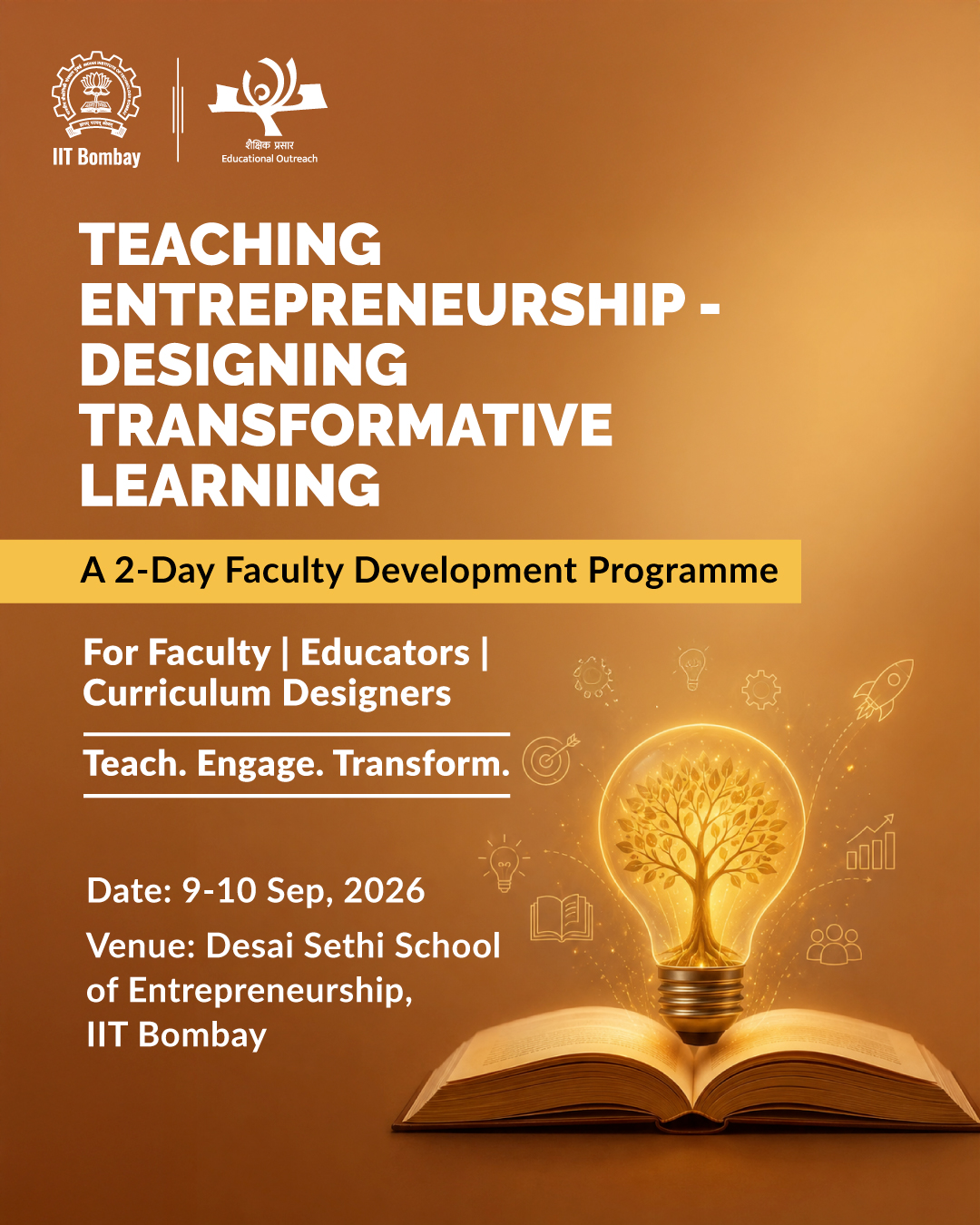
Teaching Entrepreneurship - Designing Transformative Learning

Introduction: Your students will graduate into a world that keeps changing shape. The careers they take, at home or abroad, will ask them to work with uncertainty rather than around it. That is a teaching problem before it is a career problem. IIT Bombay and the Stockholm School of Entrepreneurship invite you to an intensive day and a half of exploration and practice. You will work directly with entrepreneurial mindset and practices as they apply across disciplines and across different forms of entrepreneurship, not just startups. The focus throughout is education that creates real value for both you and your students. Engaging, experiential, grounded in reality rather than case studies from somewhere else. The premise is straightforward. An entrepreneurship educator can prepare students in any discipline for an unpredictable world, and the way you design and teach is what makes that happen. So you will learn what is working elsewhere, then spend your time converting it into methods you can use in your own classroom, with your own students, next term. Expect to leave with things you can teach, not just things you know.
Course Outline: Mapping the territory. Entrepreneurship means very different things in different contexts. You will get a clear taxonomy and learn how to work with the full range of ideas rather than defaulting to the startup version. Building the mindset, and knowing if it worked. How to develop entrepreneurial thinking and behaviours in students, and the harder question most programmes skip: how you actually assess something like this. Pedagogies that put students in motion. Experiential and action based methods, where learning comes from doing rather than being told. Co-creating with your ecosystem. Entrepreneurship education gets stronger when it is built with people outside your classroom. How to work with the ecosystem you already have, and grow it from there. Designing courses that hold attention. Curriculum built around facilitation, experimentation and feedback, so students stay engaged because the work demands something from them. The relationships that make it stick. How to bring stakeholders in properly, from industry to alumni to your own colleagues, and keep those relationships alive over time.
WHO MAY BENEFIT: This one is for the people standing in front of the classroom. Faculty teaching entrepreneurship, innovation or related subjects. Educators and trainers running entrepreneurship programmes. Faculty from any discipline who want to bring entrepreneurial learning into what they already teach. Programme managers and curriculum designers. Professionals working in entrepreneurship centres, incubators and innovation programmes. Researchers in entrepreneurship education and PhD scholars. Anyone drawn to experiential, active and learner centred teaching. You will get the most from this if you are already teaching or designing entrepreneurship related courses and want to make them more experiential, more engaging and closer to real practice.
HANDS ON FACILITY: This runs inside IIT Bombay's new Desai Sethi School of Entrepreneurship building, a six storey, 115,000 square foot facility built specifically for innovation and among the few of its kind anywhere. You will teach and learn in the kind of space you are being asked to design for: makerspaces, tinkering labs, design studios, micro factories and open co working areas where students, faculty and founders work in the same room. Seeing how a space invites experimentation is itself a lesson in course design. The format matches the setting. Little lecturing, a lot of doing. You will facilitate, experiment, give and receive feedback, and rework your own material in the room alongside peers who teach what you teach. Facilitators from the Stockholm School of Entrepreneurship bring the methods; IIT Bombay faculty keep them grounded in the classrooms you are going back to.
Download Brochure: Not Available
Coordinator: Prof. Ramesh Kuruva
IITB Faculty: Prof. Sankalp Pratap
Guest Faculty: Alberto Corti (Stockholm School of Entrepreneurship (SSES).)
Guest Faculty: Prof. Ebba Laurin (Stockholm School of Entrepreneurship (SSES).)
Course Duration: 2 Days
Dates: 09/09/2026 - 10/09/2026
Registration Last Date: 25/08/2026
Venue: DSSE
Fees: (inclusive of 18% GST) Others: INR 35400
x

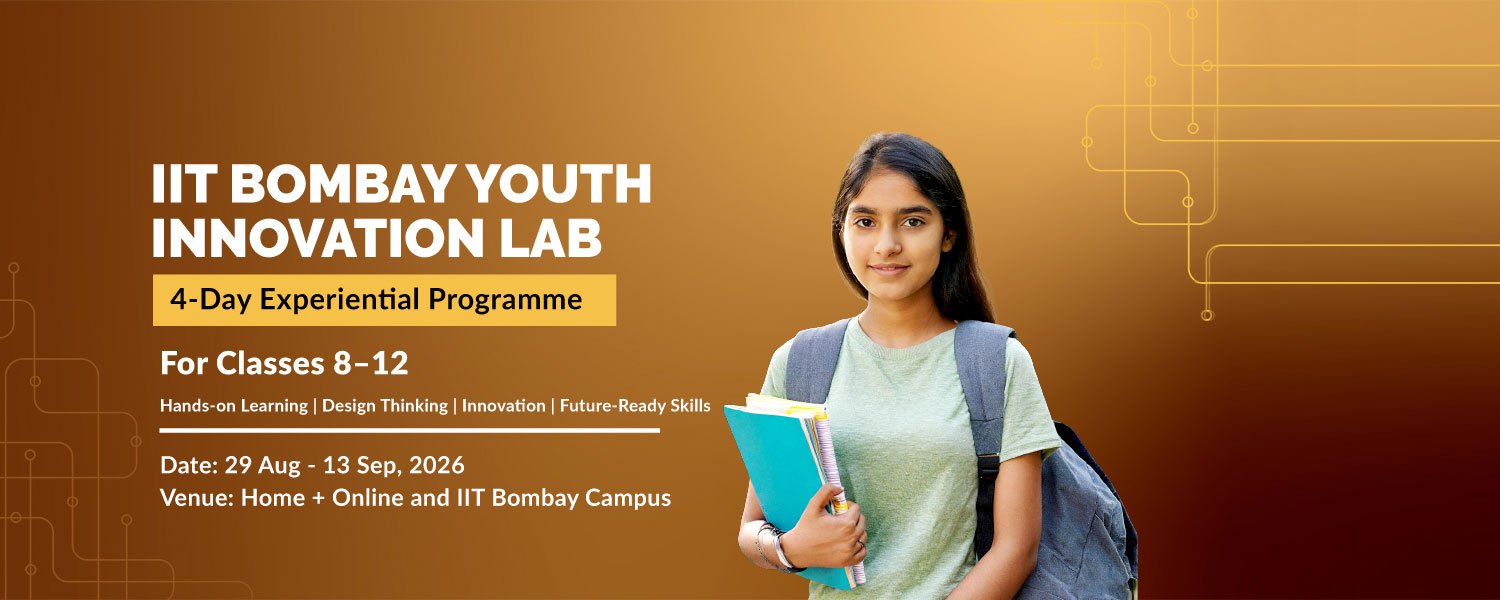
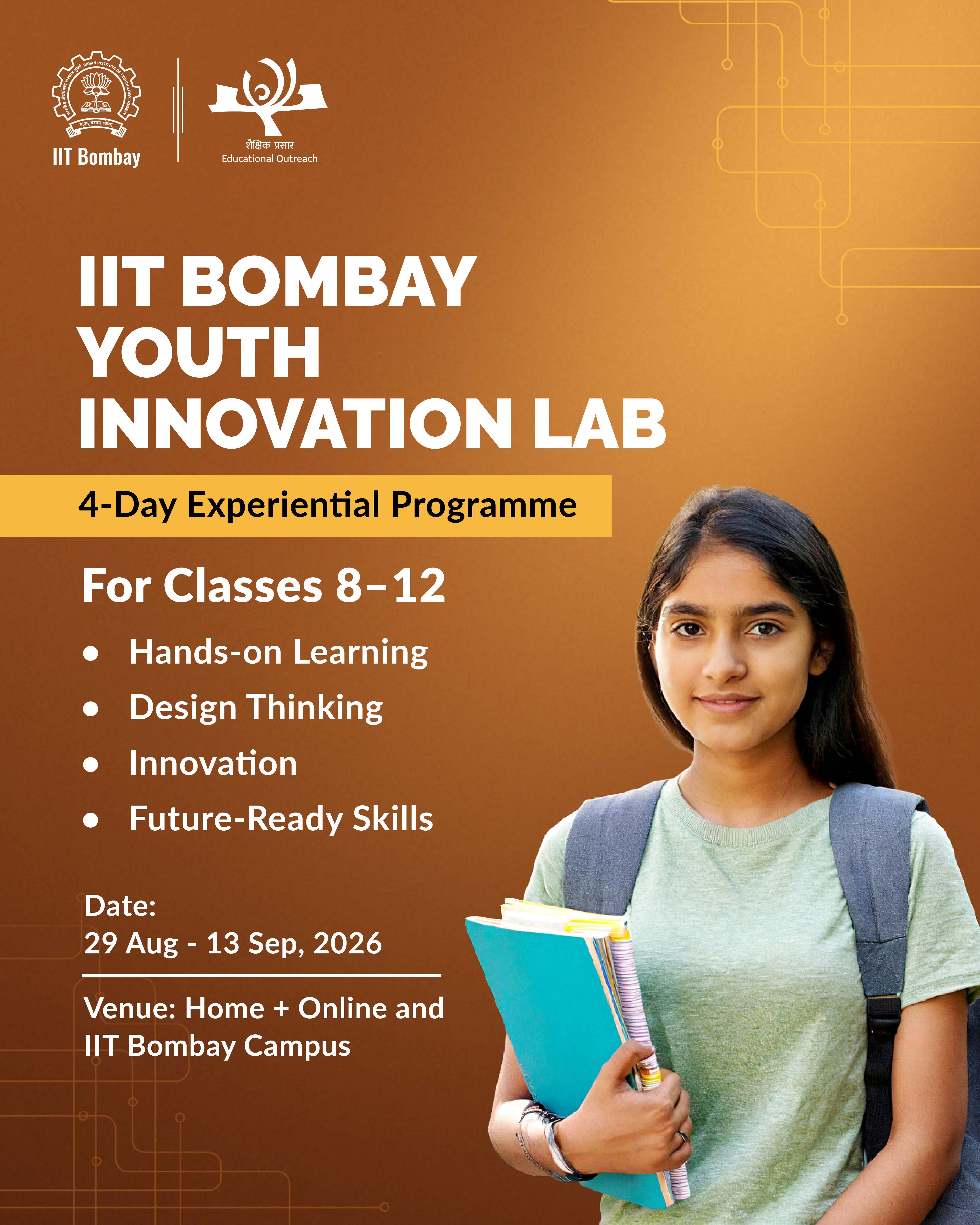
IIT Bombay Youth Innovation Lab

Introduction: The French sociologist Pierre Bourdieu showed that the dispositions which shape how we see and act in the world for the rest of our lives are formed early — during childhood and adolescence, through repeated experience at home, in school, and in the neighbourhood. This course is built on that insight. Rather than introducing innovation and entrepreneurship as a separate subject to be studied, it embeds them in the daily lives of school students as something to be lived and practised — dynamic, recursive, and inseparable from everything else they are learning. It will progress by contextualizing innovation and entrepreneurship for students leveraging access to their respective households, neighbourhoods and schools. Simultaneously, the program also aims to normalize innovation and entrepreneurship as a practice routinized through observation, discussions and experiments as part of daily living, to be carried out around one’s parents and teachers rather than as a clandestine or personal activity The program will be carried out in two distinct phases: Phase 1 (August 29 – 30): In the first phase to be carried out from home, inputs will be provided in online mode. Students will be required to carry out designated tasks in collaboration with family members / neighbours. Individual check-in will happen in the afternoon / evening to ensure that students are on the right track. At the end of this phase, students would have figured out a problem of interest and the associated stakeholders. Phase 2 (September 12 – 13) : In the second phase, students will travel to IIT Bombay and will work from the premises of DSSE, IIT Bombay. They will arrive at a solution in discussion with peers and will examine its feasibility. Subsequently, they will design and build a physical / digital model and leverage it to narrate the story of their enterprise.
Course Outline: Module: Identify Day 1 (Saturday, 29 August) — Location: Home Title: Ethnographic interviews & observations Format: 90 min live online input → independent field work → evening check-in Module: Calculate Day 2 (Sunday, 30 August) — Location: Home Title: Stakeholder mapping & constraints Format: 90 min live online input → independent mapping work from home followed by afternoon check-in Module: Design Day 3 (Saturday, 12 September) — Location: IIT Bombay Title: Design thinking & collaboration Format: Morning input + structured ideation in teams of 3 Title: Problem–solution fit and design of prototype Format: Afternoon validation and concept refinement Module: Build & Narrate Day 4 (Sunday, 13 September) — Location: IIT Bombay Title: POC lab build Format: Full-day making session; build continues into Module 6 Title: Visual narration & showcase Format: Complete POC, build narrative, present to peers
WHO MAY BENEFIT: This course is designed specifically for students of Class 8 - 12. In particular, this will benefit two kinds of students a) creative and curious students : the course will serve as an outlet for their energy and questions a) those who have got drawn excessively into the digital world: the hands-on course will help them explore a different dimension of their personality
HANDS ON FACILITY: Proof of Concept Lab at Desai Sethi School of Entrepreneurship , IIT Bombay
Download Brochure: Not Available
Coordinator: Prof. Sankalp Pratap
Course Duration: 4 Days
Dates: 29/08/2026 - 13/09/2026
Registration Last Date: 22/08/2026
Venue: DSSE Building, IIT Bombay
Fees: (inclusive of 18% GST) Others: INR 17700

The IIT Bombay
Workshop Experience

Hands-On,
Experiential Learning

Students actively build, experiment, and apply concepts—moving beyond passive learning.

Guided by
IIT Bombay Experts

Sessions are led by faculty and practitioners bringing real-world insights from research and innovation.

Learning Inside the
IIT Bombay Ecosystem

Workshops take place on campus, offering early exposure to a leading technology and research environment.

Exposure to
Future-Focused Domains

Students engage with areas like AI, robotics, design, and sustainability.

Building Confidence, Curiosity & Direction

Participants gain clarity and confidence in exploring future academic and career pathways.

Testimonials

Real experiences from students, parents, and educators
who have been part of IIT Bombay’s School Outreach programmes.

Spark your curiosity with IIT Bombay

Explore upcoming workshops and join an immersive learning experience designed by IIT Bombay experts.

Visit Campus

Educational Outreach Office
IIT Bombay, Powai
Mumbai, Maharashtra